How one dive, one photograph, and one community can become part of a global movement to protect some of the ocean’s most extraordinary animals — and the waters they call home.
“In the end, we will conserve only what we love. We will love only what we understand. And we will understand only what we are taught.”
— BABA DIOUM, SENEGALESE CONSERVATIONIST
AN INVITATION
Have You Ever Been in the Water with a Manta Ray?
If you have, you already understand something that is very difficult to explain to someone who hasn’t. There is a moment — when a manta ray turns toward you, holds its course, and passes close enough that you can see the unique spot pattern on its belly and watch its cephalic fins sweep open like great underwater wings — when something shifts. Your heartbeat changes. Your sense of where you are in the world changes. And if you are paying attention, your sense of what you are responsible for changes too.
That moment is not an accident. It is not just a memorable dive. It is the beginning of something that conservation scientists and educators have spent decades trying to understand and intentionally create: a genuine, personal connection between a human being and a living ecosystem. And it turns out that connection — that specific feeling of awe and recognition — is one of the most powerful conservation tools we have.
At ConnectOcean, in partnership with the Manta Trust, we have built an entire program around that moment. It is called the Manta Conservation Explorer PADI Distinctive Specialty — and it is an invitation to everyone who loves the ocean to become part of a growing global effort to protect manta rays and the extraordinary ecosystems they inhabit.
Conservation is not something that happens somewhere else. It starts with us — with the people who live, work, and dive in these waters every day.
Here in Guanacaste, we are extraordinarily lucky. The waters around the Las Catalinas Islands are one of the few places in the Pacific where oceanic manta rays aggregate seasonally, returning year after year to feed, clean, and travel a migratory corridor that stretches the length of Costa Rica’s Pacific coast. Watching a manta glide past in open water here is not a distant dream — for the right community, equipped with the right knowledge and tools, it is a regular, extraordinary reality.
But extraordinary things require protection. And protection, as we have learned time and again in marine conservation, does not come from rules alone. It comes from people who care. Our mission is to help build that community of people — and we want you to be part of it.
WHY THIS MATTERS NOW
The Ocean Needs a Different Kind of Conservation
We are living through a pivotal decade for the ocean. The United Nations has declared 2021–2030 the Ocean Decade for Sustainable Development, and the global community has committed to protecting 30% of the world’s ocean by 2030 — a target known as 30×30. It is an ambitious and necessary goal. Yet today, only about 3% of the global ocean is effectively protected. At the current pace, meeting the 30×30 target would take another 75 years.
Clearly, something different is needed. And that something is people.
For too long, conservation has relied almost entirely on what researchers call a top-down approach: large institutions, governments, and international organizations making decisions about what to protect and how, while the communities closest to those ecosystems are left out of the conversation. It is an approach that has produced important progress — but it has also produced an ocean where conservation exists on paper far more often than it exists in practice.
THE SHIFT WE NEED
Nearly 40% of the global population lives within 100 kilometres of the coast. No government, no NGO, no international treaty can protect the ocean as effectively as the communities whose lives, livelihoods, and identities are already woven into it.
The most effective marine conservation in the world happens when local communities become genuine partners and stewards — not stakeholders to be informed, but leaders who understand the value of what they are protecting and feel personally invested in its future. Around Las Catalinas, that means the dive instructors, the boat captains, the tour guides, the fishing cooperatives, the students and schoolteachers, the families who have lived on this coast for generations. It means you.
ConnectOcean and the Manta Trust are building the framework to make that possible. And the foundation of that framework is a beautifully simple idea: before people can protect the ocean, they first need to fall in love with it.
THE FRAMEWORK
Discover · Connect · Protect
Think about your best friend. Can you remember the first day you met them? At that moment, they were simply someone you had just been introduced to — there was no deep connection, no sense of loyalty or commitment. Now think about how you feel about them today, after years of shared experiences, discoveries, and moments that mattered. The difference between those two moments is not information. It is relationship.
Nature works in exactly the same way. For most of human history, people lived in close, daily relationship with the natural world. They knew the names of the birds around them, the behavior of the fish in their local waters, the seasonal cycles of the ecosystems that sustained them. That intimacy created stewardship — not because it was required, but because you protect what you love. Over the last century, as societies modernized, many of us lost that closeness. And with it, we lost much of our instinct to protect.
The Discover → Connect → Protect model is designed to rebuild that relationship — one person, one community, one ecosystem at a time.
01 DISCOVER
Curiosity is the spark. Before anyone can care about manta rays, they need to experience them — in the water, up close, with the knowledge to understand what they are seeing. Discovery transforms the unfamiliar into the astonishing.
02 CONNECT
Connection is built over time, through repeated encounters and deepening understanding. When a diver begins to recognize individual mantas by their spot patterns — when the ocean stops being a backdrop and starts being a community — something profound has happened.
03 PROTECT
Protection follows naturally from connection. When these waters belong to you — not in a legal sense, but in the deepest sense of caring about what happens here — you become an advocate, a steward, and a guardian without being asked.
This sequence is not just a curriculum design. It is a description of how human beings actually come to care about the natural world. Knowledge alone doesn’t move people to act. Laws alone don’t create stewards. What creates lasting, community-driven conservation is personal experience, deepened by understanding, transformed over time into genuine connection — and ultimately into the kind of passionate, voluntary protection that no enforcement budget can replicate.
STAGE ONE
Discovery: The Manta Ray as Your Gateway to the Ocean
Every great conservation story begins with an encounter. For many people working in ocean conservation today, there is a specific moment — a specific dive, a specific animal, a specific morning on the water — that changed the direction of their life. The Manta Conservation Explorer program is designed to create those moments deliberately and share them widely.
Oceanic manta rays — the species that visits the Las Catalinas Islands seasonally — are, by almost any measure, one of the most extraordinary animals in the ocean. They are the world’s largest rays, reaching wingspans of up to seven meters. They are filter feeders with no sting, no aggression, and an apparently genuine curiosity about the divers and snorkelers they encounter. Their brains are disproportionately large for fish of their size — warmed by a specialized vascular network and supported by complex social behavior that researchers believe indicates higher intelligence. A manta ray that circles a diver at a cleaning station is not posturing or patrolling. It is, in all likelihood, interested in you.
WHAT DISCOVERY FEELS LIKE
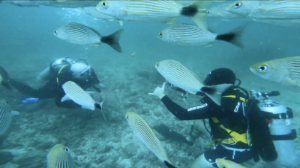
Snorkeling over a reef and watching schools of fish shimmer in the sunlight. Seeing a manta ray glide effortlessly through open water. In moments like these, something important happens — knowledge transforms into personal connection. And that connection is the beginning of everything.
The discovery phase of our program is built around exactly these moments. Through the e-learning program and in-water field sessions, participants learn to observe mantas with the eyes of a scientist and the heart of someone genuinely amazed. They learn the behavioral signs that tell the difference between a manta feeding, cleaning, courting, and resting. They learn to slow down, observe carefully, and let the encounter unfold on the animal’s terms — which, it turns out, produces encounters of extraordinary intimacy and duration.
And crucially, they learn that what they are experiencing is not just a thrill. It is participation in something larger. The manta rays of Las Catalinas are part of a population that scientists, through decades of painstaking research and citizen science, are only beginning to understand. Every sighting, every photograph, every observation contributes to that understanding. Discovery, in our program, is also contribution — and that combination is remarkably powerful.
This is the philosophy behind citizen science as a conservation tool: removing the barrier between the public and the scientific process, and showing communities that you do not need a laboratory or a PhD to contribute meaningful knowledge about the natural world. With the right training, anyone in the water with a manta ray can become part of the global effort to protect them.