There is something almost magical about watching a sea turtle emerge from the ocean at night.
She moves slowly across the sand, stopping occasionally as if to make sure the beach is safe. Then, with an instinct that has guided generations of turtles, she begins to dig. Within minutes, she is creating a nest that will hold dozens, sometimes more than a hundred eggs.
For many travelers, this is where the story of Costa Rica’s sea turtles begins.
But it is only one chapter.
Once those eggs hatch and the tiny turtles disappear into the waves, their lives become much harder to follow. They enter a vast world beneath the surface, traveling through coastal waters and the open ocean, feeding, growing and eventually returning to the beaches where their own lives began.
Costa Rica’s sea turtles live between two very different worlds: the beaches where they are born and the ocean that becomes their home.
Costa Rica’s beaches are nurseries for sea turtles
Costa Rica is one of the world’s important nesting grounds for several species of sea turtles, including green turtles, hawksbill turtles, leatherbacks and olive ridleys.
Each species has its own nesting habits, preferred habitats and migration patterns. Some arrive individually throughout the nesting season, while others are famous for spectacular mass nesting events known as arribadas.
Along Costa Rica’s Pacific coast, olive ridley turtles are particularly well known for these extraordinary gatherings. Thousands of females can arrive at certain beaches within a relatively short period, creating one of nature’s most remarkable wildlife spectacles.
On the Caribbean coast, Tortuguero is internationally recognized for its importance to green sea turtles and leatherbacks.
But regardless of the species, nesting is an exhausting process.
A female turtle may travel hundreds or thousands of kilometers through the ocean before reaching a nesting beach. Once ashore, she must find a suitable place above the high tide line, dig a chamber with her rear flippers and deposit her eggs.
Then she covers the nest carefully with sand.
She returns to the ocean, leaving behind what looks like an ordinary patch of beach.
Hidden underneath, however, an entire generation is waiting.
The race from nest to ocean
Weeks later, the eggs begin to hatch.
The hatchlings emerge from the nest, often together. They wait until conditions are favorable and then make their way toward the surface.
What happens next is one of the most dangerous journeys of their lives.
The tiny turtles must cross the beach before reaching the water. Birds, crabs, mammals and other predators can all pose a threat. Even once they reach the ocean, their challenges continue.
The young turtles swim away from shore, entering a world where survival depends on finding food, avoiding predators and conserving energy.
For many species, the first years of their lives remain surprisingly mysterious.
Scientists call this period the “lost years” because young turtles spend much of their early life far from the nesting beaches where they can be easily observed.
And this is where the story moves from the beach to the open ocean.
A life beneath the surface
Sea turtles are not simply creatures that visit the ocean between nesting seasons.
They are marine animals adapted to an extraordinary life at sea.
Depending on the species and stage of life, turtles may spend years traveling through coastal waters, offshore areas and the open ocean.
Leatherback turtles, for example, are remarkable long-distance travelers. Their enormous bodies and unique adaptations allow them to dive deep and travel across entire ocean basins in search of food.
Green turtles have a different lifestyle. As adults, many shift toward a diet dominated by seagrasses and algae, making coastal habitats particularly important.
Hawksbill turtles are strongly associated with coral reefs and rocky coastal ecosystems, where their narrow, specialized beaks allow them to feed on organisms found within reef environments.
These differences matter because protecting sea turtles is not simply about protecting nesting beaches.
A turtle needs a healthy ocean, too.
What sea turtles are doing beneath Costa Rica’s waters
For divers and snorkelers, encountering a sea turtle underwater can feel like a brief meeting with an ancient traveler.
A turtle may appear from the blue, glide over a reef and disappear again just as quietly.
But there is much more happening beneath the surface than these encounters reveal.
Sea turtles are part of complex marine ecosystems. Their feeding habits can influence habitats, while their movements connect coastal environments with much larger ocean systems.
Green turtles can help maintain healthy seagrass ecosystems through grazing. Hawksbills interact with coral reef ecosystems through their specialized feeding behavior. Leatherbacks play a role in marine food webs as predators of jellyfish and other soft-bodied organisms.
Their presence can therefore tell us something about the health and connectivity of the marine environment.
And because turtles travel so far, threats in one place can affect animals that spend part of their lives somewhere else.
The journey is bigger than Costa Rica
One of the most fascinating things about sea turtles is that their relationship with Costa Rica does not end at the country’s coastline.
Many turtles undertake extraordinary migrations between feeding grounds and nesting beaches.
A turtle nesting on a Costa Rican beach may later travel far offshore or across international waters. Another turtle feeding in Costa Rican waters may eventually return to a completely different coastline to reproduce.
The ocean has no borders for these animals.
This is one reason marine conservation is so interconnected. Protecting a nesting beach is essential, but it is only part of the solution. Turtles also need safe migration routes, healthy feeding grounds and productive marine ecosystems.
For Costa Rica, that means conservation has to continue beyond the sand.
Why seeing a turtle underwater is different
Watching a turtle nest on a beach and encountering one underwater are two completely different experiences.
On the beach, you are witnessing a critical moment in the turtle’s reproductive cycle.
Underwater, you are seeing the animal in its natural environment, moving through the ecosystem that sustains it.
You may see a turtle resting beneath a rocky ledge, feeding along a reef or simply gliding through open water.
There is no guarantee.
And that is part of what makes the experience special.
Wildlife encounters are not performances. The ocean decides what appears, when it appears and for how long.
A responsible dive or snorkeling experience gives the animal space while allowing you to observe without interfering with its behavior.
How to experience Costa Rica’s sea turtles responsibly
If you encounter a sea turtle while snorkeling or diving, the best approach is simple: observe, don’t chase.
Give the turtle room to move naturally. Avoid touching it, feeding it or blocking its path to the surface. Keep your movements calm and allow the animal to decide how close it wants to come.
The same principle applies on nesting beaches.
Sea turtles are especially vulnerable when they come ashore. Bright lights, noise, crowds and physical interference can disrupt nesting behavior or affect hatchlings trying to reach the ocean.
That is why guided turtle experiences and conservation programs can make such a difference. Knowledgeable local guides understand how to observe turtles while minimizing disturbance and can help visitors understand what they are seeing.
The goal isn’t simply to get closer to wildlife.
It is to understand it.
The ocean connection
There is a reason sea turtles have survived for millions of years.
They are extraordinarily adapted to a life that connects beaches, reefs, coastal waters and the open ocean.
A turtle nesting on a Costa Rican beach is part of something much larger than that single stretch of sand. Her journey connects Costa Rica with distant feeding grounds, migration routes and marine ecosystems across the region.
And when a turtle glides past you underwater, you are seeing only a small moment in a much longer story.
Perhaps that is the secret life of Costa Rica’s sea turtles.
We see them arrive at the beach.
We see them disappear beneath the waves.
But between those two moments is an entire world.
For those willing to look beneath the surface, Costa Rica’s ocean reveals a much bigger story: one of migration, survival and an extraordinary connection between land and sea.
Discover Costa Rica beneath the surface
At ConnectOcean, we believe that exploring the ocean is also an opportunity to understand it.
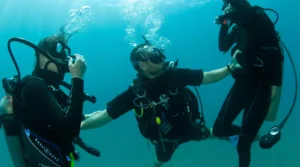
Our dive experiences in Costa Rica take you beyond the postcard version of the Pacific, into a living marine environment where turtles, rays, reef fish, sharks and other species share the same waters.
You may come looking for a turtle.
What you discover is an entire ecosystem.