If you’re planning a dive trip to Costa Rica, this question comes up almost immediately:
Pacific or Caribbean?
It sounds simple, but the answer depends entirely on what kind of underwater experience you’re looking for.
Because in Costa Rica, these two coasts don’t just look different above water.
They feel completely different below the surface too.
Two oceans, two completely different worlds
Costa Rica sits between the Pacific Ocean and the Caribbean Sea, and each side offers a distinct diving environment.
The Pacific, especially in the northwest, is known for:
- Stronger currents.
- Nutrient-rich waters.
- Bigger marine life encounters.
The Caribbean, on the other hand, is typically:
- Calmer and more predictable.
- Warmer on average.
- More focused on coral reefs and smaller marine life.
Neither is “better” in absolute terms.
But one might be better for you.
Diving on the Pacific side
This is where most of Costa Rica’s diving reputation comes from.
Along the Guanacaste coast, sites like the Catalinas Islands have become known for encounters that feel a bit more wild and unpredictable, in the best way.
Here, conditions can change from one dive to the next. Visibility, currents, temperature… it is all part of the experience.
But that variability is exactly what attracts:
- Giant manta rays.
- Schools of mobula rays.
- Reef sharks.
- Large schools of fish.
It is not always easy diving, but it is often rewarding.
This side tends to appeal more to:
- Certified divers.
- People looking for marine life encounters.
- Travelers who want something a bit less perfect and a bit more real.
Diving on the Caribbean side
The Caribbean coast of Costa Rica offers a completely different rhythm.
Think calmer waters, softer conditions, and a slower pace overall.
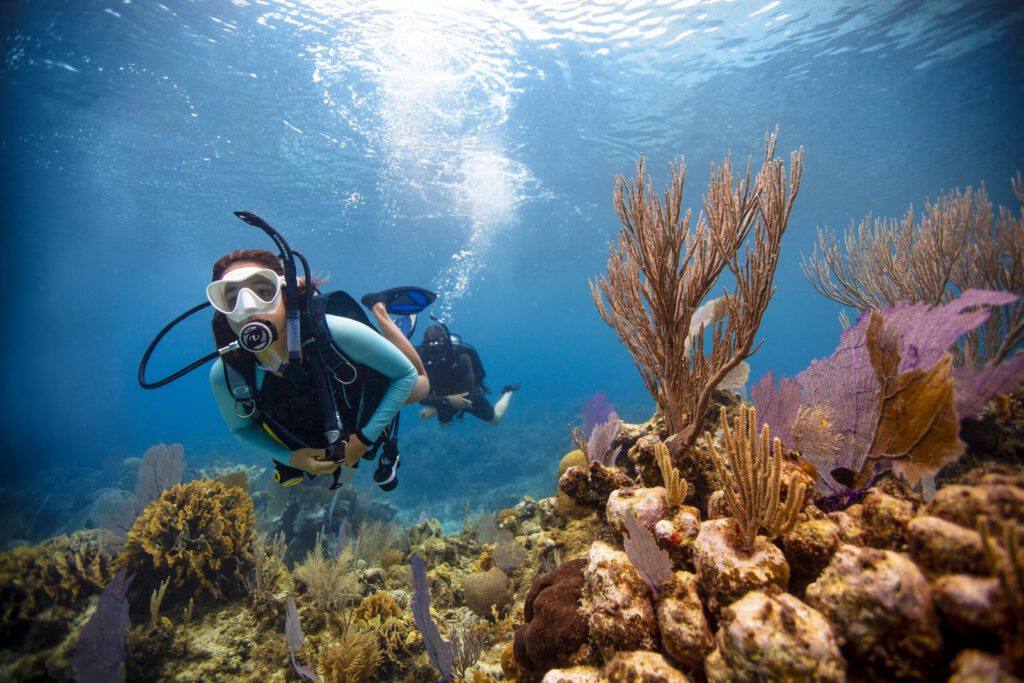
Areas like Cahuita are known for coral reef systems, especially within Cahuita National Park.
Here, diving is typically:
- More relaxed.
- More accessible for beginners.
- Focused on reef ecosystems rather than big pelagics.
You are more likely to see:
- Colorful tropical fish.
- Coral formations.
- Smaller marine creatures.
It is less about adrenaline and more about observation.
Visibility, conditions, and seasonality
One important factor is that conditions vary throughout the year on both coasts.
- The Pacific can have changing visibility due to plankton, which is also why big animals come.
- The Caribbean can offer excellent clarity at times, but is more affected by rainfall and river outflows.
In other words, there is no single perfect side year round, just different windows and moods.
So, which side is better?
If your idea of diving includes:
- Large marine life.
- Dynamic conditions.
- A sense of exploration.
Then the Pacific will likely feel more aligned.
If you prefer:
- Calm, easy diving.
- Reef-focused environments.
- A more relaxed introduction to diving.
Then the Caribbean might be the better fit.
Our perspective
We have always seen it this way:
The Caribbean shows you the details of the ocean.
The Pacific shows you its power.
Both matter.
Both are worth experiencing.
But if you are coming to Costa Rica looking for those moments that stay with you, the unexpected encounters, the feeling that something big could appear out of the blue, you will probably find yourself drawn to the Pacific.
And whichever side you choose (even if you can dive in both), one thing stays the same:
Costa Rica is not just a place to dive.
It is a place to connect with the ocean in a way that feels a little more alive.